Course Summary
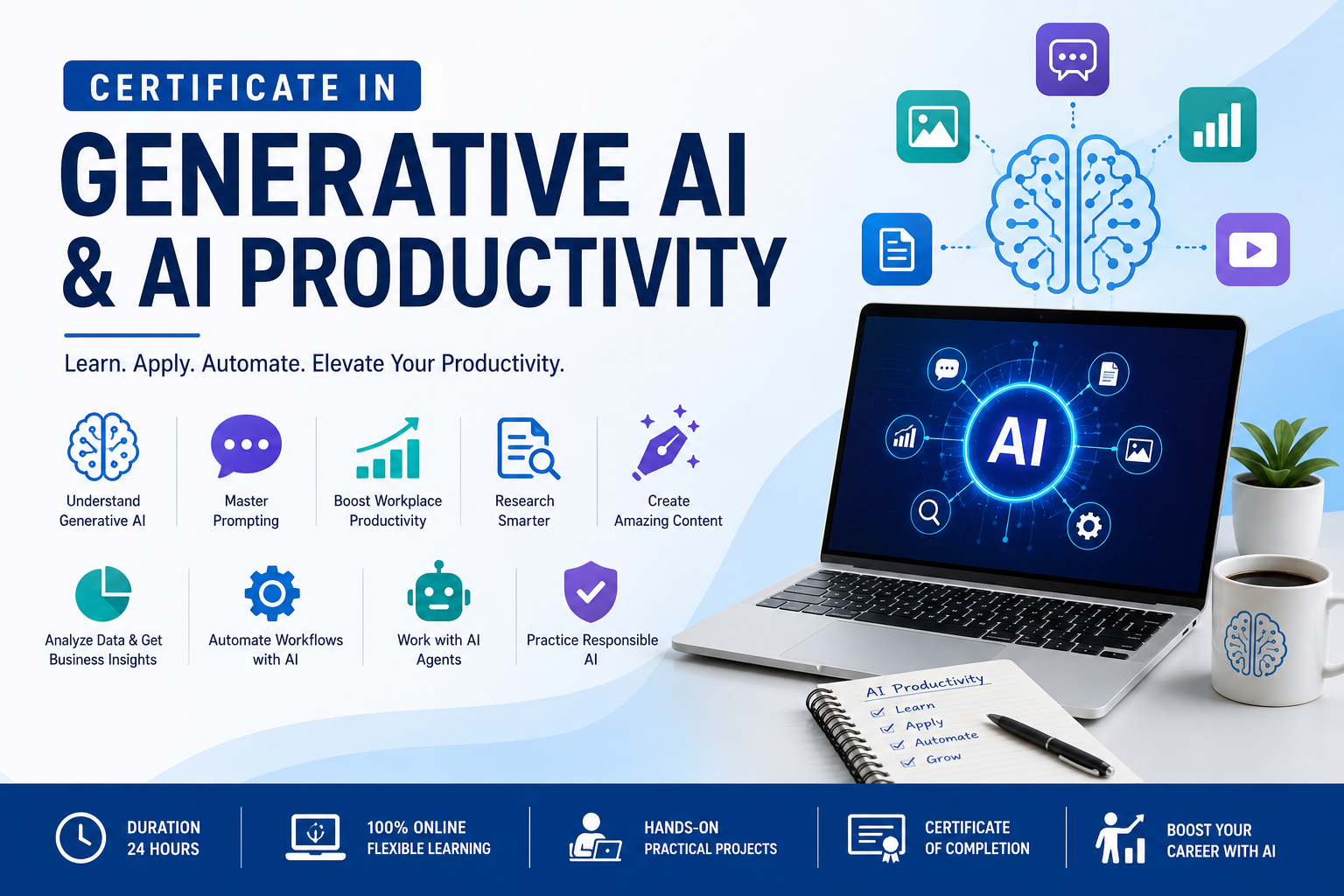
Certificate in Generative AI & AI Productivity
Duration: 24 Hours
Mode: Online
Level: Beginner to Applied
Prerequisite: Basic computer literacy; no programming knowledge required
Target Audience: Students, graduates, working professionals, educators, researchers, entrepreneurs, freelancers and career switchers
Course Overview
The Certificate in Generative AI & AI Productivity is a practical, industry-oriented 24-hour online certification designed to equip learners with the knowledge and hands-on skills required to understand, use and apply Generative Artificial Intelligence in academic, professional and business environments.
The program goes beyond the conventional introduction to Artificial Intelligence by focusing on how learners can actually use AI to improve productivity, communication, research, content creation, data analysis, decision support and workflow automation. Rather than treating Generative AI merely as a theoretical technology, the certification positions it as a practical productivity and career-enablement tool.
The course takes learners through a structured progression from understanding Generative AI to applying AI in real-world tasks and ultimately designing AI-enabled workflows and productivity solutions. The learning journey follows the sequence:
Understand AI → Prompt AI → Apply AI → Create with AI → Analyze with AI → Automate with AI → Govern AI → Build an AI Portfolio
The certification is intentionally designed for both technical and non-technical learners. Participants are not expected to have prior knowledge of programming, machine learning, data science or artificial intelligence. Instead, the course introduces complex AI concepts through practical demonstrations, guided exercises, real-world examples, case studies and project-based learning.
Why This Course?
Generative AI is rapidly changing the way individuals and organizations perform knowledge-intensive work. Activities such as drafting emails, preparing reports, researching information, creating presentations, analyzing data, developing marketing content, documenting meetings and designing workflows can increasingly be supported by AI.
However, simply knowing how to access an AI chatbot is not sufficient professional competence.
The real value lies in knowing:
- What to ask AI
- How to provide the right context
- How to structure effective prompts
- How to evaluate AI-generated information
- How to integrate AI into existing workflows
- How to combine multiple AI tools
- Where human judgment is still essential
- How to automate repetitive tasks responsibly
- How to protect confidential and sensitive information
- How to demonstrate AI skills through practical portfolio evidence
The certification therefore focuses on developing applied AI productivity capability, rather than only providing theoretical awareness.
Course Philosophy
The program is based on five core principles:
1. Learn by Doing
A substantial proportion of the course is devoted to demonstrations, guided exercises, practical activities, case studies and project work.
2. Workplace Application
Learners work with scenarios drawn from areas such as:
- Business
- Finance
- Banking
- Marketing
- Human Resources
- Education
- Retail
- E-commerce
- Research
- IT services
- Administration
3. Tool-Agnostic Learning
Although learners will be introduced to widely used Generative AI platforms and productivity tools, the course emphasizes transferable concepts and workflows rather than dependence on a single AI platform.
4. Portfolio-Oriented Learning
Learners produce tangible outputs throughout the program, including prompts, research briefs, presentations, data-analysis reports and AI workflows.
5. Responsible AI
The course integrates privacy, accuracy, hallucination, bias, copyright, intellectual property, academic integrity and human oversight into practical AI usage.
Course Structure
The 24-hour certification consists of eight integrated modules, each designed around a specific AI competency.
| Module | Course Component | Hours |
|---|---|---|
| 1 | Generative AI Foundations | 3 |
| 2 | Prompt Engineering & AI Communication | 3 |
| 3 | AI for Personal & Workplace Productivity | 3 |
| 4 | AI for Research, Learning & Knowledge Work | 3 |
| 5 | AI for Content, Presentations & Creativity | 3 |
| 6 | AI for Data Analysis & Business Intelligence | 3 |
| 7 | AI Automation, Workflows & Agents | 3 |
| 8 | Responsible AI, Ethics & Capstone | 3 |
| Total | Certificate Program | 24 Hours |
Module 1: Generative AI Foundations
The first module establishes the conceptual foundation required to work confidently with modern AI systems.
Learners are introduced to:
- Artificial Intelligence
- Machine Learning
- Deep Learning
- Generative AI
- Traditional AI versus Generative AI
- Large Language Models
- Foundation models
- Tokens
- Context windows
- Multimodal AI
- AI reasoning
- AI hallucinations
- AI agents
- The modern Generative AI ecosystem
The emphasis is not on mathematical or programming-based treatment. Instead, learners develop a practical understanding of what modern AI systems can do, what they cannot reliably do and how they should be used.
Practical component
Learners compare AI-assisted information retrieval with conventional approaches and perform a basic AI-output verification exercise.
Expected output
Generative AI Capability Map
Module 2: Prompt Engineering & AI Communication
Effective use of Generative AI depends heavily on the quality of instructions provided to the system. This module introduces learners to prompt engineering as a practical professional skill.
Learners explore:
- Prompt fundamentals
- Role prompting
- Context provision
- Task specification
- Constraints
- Output formatting
- Zero-shot prompting
- Few-shot prompting
- Structured prompting
- Prompt refinement
- Iterative prompting
- Prompt evaluation
- Prompt templates
- Professional prompt libraries
A core prompting framework used throughout the course is:
ROLE + CONTEXT + TASK + CONSTRAINTS + OUTPUT FORMAT
Learners learn to transform weak, generic prompts into structured professional prompts.
Practical component
Participants develop prompts for:
- Email writing
- Research
- Data analysis
- Marketing
- HR
- Business reporting
- Education
- Customer support
Expected output
20-Prompt Professional AI Library
Module 3: AI for Personal & Workplace Productivity
This module demonstrates how Generative AI can be integrated into everyday professional activities.
Learners practice using AI for:
- Email drafting
- Email summarization
- Meeting preparation
- Meeting summarization
- Action-item extraction
- Task planning
- Checklists
- SOP development
- Report preparation
- Brainstorming
- Decision-support frameworks
- Professional communication
- Work planning
A central concept is:
AI should augment human productivity rather than simply generate content.
Learners therefore explore the complete workflow:
Input → AI Assistance → Human Review → Final Output
Practical project
Participants design an AI-Assisted Workday Workflow covering activities such as planning, communication, meetings, documentation and reporting.
Expected output
AI Productivity Workflow
Module 4: AI for Research, Learning & Knowledge Work
Generative AI can significantly assist research and knowledge-intensive activities, but effective use requires source verification and critical evaluation.
This module teaches learners how to use AI for:
- Research question development
- Information discovery
- Literature exploration
- Document summarization
- Document comparison
- Information extraction
- Research frameworks
- Interview-question development
- Survey/questionnaire design
- Knowledge synthesis
- AI-assisted learning
- Personalized learning
- Fact verification
- Citation verification
Learners are introduced to a structured research workflow:
Question → Search → Analyze → Verify → Synthesize → Draft → Review
Particular attention is given to the risks of fabricated information, unsupported claims and unreliable references.
Practical project
Learners create an:
AI-Assisted Research Brief
The output must distinguish between AI-generated assistance and verified information.
Module 5: AI for Content, Presentations & Creativity
This module focuses on the creative and communication capabilities of Generative AI.
Learners explore AI-assisted:
- Professional writing
- Reports
- Articles
- Blog content
- Social media content
- Marketing copy
- Presentation development
- Storytelling
- Visual ideation
- Image generation
- Video-script creation
- Audio/voice concepts
- Content repurposing
A major practical concept is:
ONE SOURCE → MULTIPLE CONTENT FORMATS
For example, a single research report can be transformed into:
Presentation → LinkedIn post → Email → Video script → Infographic → Executive summary
Practical project
Learners create a complete AI-Assisted Professional Content Package.
This may include:
- Presentation
- Written content
- Social-media content
- Visual asset
- Short video script
Module 6: AI for Data Analysis & Business Intelligence
This module introduces learners to non-programming approaches for using AI in data analysis and business intelligence.
Learners explore:
- Spreadsheet analysis
- CSV analysis
- Data summarization
- Data-cleaning concepts
- Trend identification
- Descriptive analysis
- Tables
- Charts
- Business insights
- What-if analysis
- Sales analysis
- Customer analysis
- Basic financial analysis
The module emphasizes that AI-generated analysis must be checked against the underlying data.
Practical datasets
Learners work with simulated datasets such as:
- Sales performance
- Customer information
- Business/financial performance
Practical project
AI-Assisted Business Analytics Report
The report should contain:
- Key findings
- Trends
- Supporting data
- Visual interpretation
- Business recommendations
- Limitations
Module 7: AI Automation, Workflows & Agents
This module moves beyond individual AI interactions toward AI-enabled process design.
Learners are introduced to:
- AI automation
- No-code automation
- AI workflows
- Trigger-process-output architecture
- AI-powered workflows
- AI agents
- Agentic AI concepts
- Human-in-the-loop systems
- Workflow optimization
- Automation opportunities
- Automation risks
The core workflow structure is:
TRIGGER → PROCESS → AI → HUMAN REVIEW → OUTPUT
Examples include:
Workflow 1
Email → Classification → Summary → Task List
Workflow 2
Document → Information Extraction → Spreadsheet → Report
Workflow 3
Customer Query → Classification → Response Draft → Human Approval
Learners are taught to distinguish between tasks that can be automated and decisions that should remain under human supervision.
Practical output
AI Workflow & Automation Blueprint
Module 8: Responsible AI, Ethics & Capstone
The final module combines responsible AI principles with the practical capstone project.
Learners examine:
- AI ethics
- Bias
- Privacy
- Data protection
- Copyright
- Intellectual property
- Academic integrity
- Deepfakes
- Misinformation
- AI hallucinations
- Human oversight
- Responsible AI
- AI governance
Particular emphasis is placed on the principle:
Never place confidential or sensitive information into a public AI system without appropriate authorization.
Learners also conduct an AI Output Risk Audit, examining:
- Accuracy
- Bias
- Privacy
- Hallucination
- Copyright
- Human-review requirements
Capstone Project
AI Productivity & Automation Portfolio
The capstone is designed to transform course learning into demonstrable employability evidence.
Each learner identifies an academic, professional or business problem and develops an AI-assisted solution.
The project includes:
- Problem statement
- Existing/manual process
- AI opportunity
- Tool selection
- Prompt design
- AI workflow
- Generated output
- Human validation
- Productivity assessment
- Risk assessment
- Recommendations
- Final presentation
Possible projects include:
- AI-powered HR workflow
- AI-assisted financial reporting
- AI research assistant
- AI marketing campaign
- AI customer-support workflow
- AI academic productivity system
- AI sales reporting workflow
- AI meeting-to-action workflow
- AI document-processing workflow
The final capstone becomes a key component of the learner's AI Productivity Portfolio.
Practical Learning & Portfolio Outputs
By the end of the certification, each learner should have a collection of practical work products.
Core portfolio
1. Professional Prompt Library
A collection of structured prompts for different professional tasks.
2. AI Productivity Workflow
A documented workflow showing how AI improves a real-world task.
3. AI-Assisted Research Brief
A research output demonstrating AI-assisted information synthesis and verification.
4. AI Data Analysis Report
An analysis of a structured dataset using AI-assisted techniques.
5. AI Productivity & Automation Capstone
A complete AI-enabled solution to a real-world problem.
These outputs provide learners with tangible evidence of applied AI skills that can be discussed during interviews, included in professional portfolios and referenced on resumes or professional networking profiles.
Key Skills Developed
The certification develops a multidimensional AI competency profile.
| Skill Area | Competency Developed |
|---|---|
| Generative AI Literacy | Understanding modern AI systems |
| Prompt Engineering | Designing effective AI instructions |
| AI Productivity | Improving workplace tasks |
| AI Research | Research and knowledge synthesis |
| AI Content Creation | Text, presentation and visual content |
| AI Data Analysis | AI-assisted analysis of structured data |
| AI Automation | Workflow and process design |
| AI Agents | Understanding agentic workflows |
| AI Evaluation | Reviewing AI outputs |
| Responsible AI | Ethical and safe AI usage |
| Digital Productivity | AI-enhanced professional work |
| Problem Solving | Identifying AI opportunities |
Industry & Career Applications
The skills developed through the certification can support AI-enabled work across a wide range of roles.
Business & Management
- Business analysis
- Management reporting
- Documentation
- Decision support
Finance
- Financial-report summarization
- Spreadsheet analysis
- Business insights
- Research assistance
Marketing
- Content creation
- Campaign development
- Customer analysis
- Social-media planning
Human Resources
- Job-description creation
- Interview preparation
- HR documentation
- Candidate-information processing
Education
- Lesson planning
- Assessment creation
- Research assistance
- Learning-material development
Operations
- SOP creation
- Process documentation
- Workflow optimization
- Automation
Customer Service
- Query classification
- Response drafting
- Knowledge-base development
- Customer-feedback analysis
Entrepreneurship
- Market research
- Content generation
- Business planning
- Process automation
Assessment Approach
The certification uses a competency-based assessment model rather than relying solely on a final examination.
| Assessment Component | Weight |
|---|---|
| Module Quizzes | 20% |
| Practical Exercises | 20% |
| Prompt Engineering Assignment | 15% |
| Industry Case Study | 15% |
| Capstone Project | 30% |
| Total | 100% |
This ensures that learners are assessed on both knowledge and practical application.
Learning Methodology
The program uses a combination of:
- Instructor demonstrations
- Guided hands-on exercises
- AI tool exploration
- Case studies
- Problem-based learning
- Scenario-based learning
- Prompt-writing activities
- Data-analysis exercises
- Workflow-design activities
- Individual assignments
- Capstone project
The program is designed so that learners continuously move between:
Learn → Demonstrate → Practice → Apply → Evaluate → Creat
Certification
Learners who satisfy the prescribed completion and assessment requirements receive:
Certificate in Generative AI & AI Productivity
The certificate records:
- Learner name
- Certification title
- 24 learning hours
- Certificate number
- Issue date
- Authorized signatory
- Verification mechanism
- Core competencies
The certification should be positioned as an applied skills certification, and any claims regarding accreditation or statutory recognition should be made only where the issuing institution actually holds the relevant authorization.
Who Should Enroll?
This certification is particularly suitable for learners who want to understand how Generative AI can be integrated into their existing field rather than necessarily becoming AI programmers.
It is appropriate for:
- Undergraduate students
- MBA students
- BBA/B.Com students
- Engineering students
- Computer applications students
- Working professionals
- Managers
- Faculty members
- Researchers
- Entrepreneurs
- Freelancers
- Job seekers
- Career switchers
- Administrative professionals
- Business professionals
What Makes the Certification Different?
The key differentiator is the transition from:
"Learning about AI"
to:
"Learning how to work with AI."
The certification does not end with an online quiz or a certificate. Learners are expected to create practical AI-enabled outputs and a portfolio demonstrating their ability to use Generative AI for real-world work.
The program therefore combines:
AI Literacy + Prompt Engineering + Productivity + Research + Content + Data + Automation + Responsible AI + Portfolio
within a compact 24-hour online certification.
Final Course Proposition
Certificate in Generative AI & AI Productivity
A practical 24-hour online certification designed to help learners understand Generative AI, master effective prompting, enhance workplace productivity, conduct AI-assisted research, create professional content, analyze data, design AI-powered workflows and apply AI responsibly—while building a practical portfolio of AI-enabled work.
Core learner transformation
Before the course:
"I have heard about Generative AI and occasionally use AI tools."
After the course:
"I can identify where AI can add value, design effective prompts, use AI for professional tasks, evaluate its outputs, analyze information, create AI-assisted workflows, automate appropriate processes and demonstrate my skills through a practical AI portfolio."
The central promise
Learn AI. Apply AI. Automate Work. Build Your AI Productivity Portfolio.